Follow Us @soratemplates

Posts mit dem Label en werden angezeigt. Alle Posts anzeigen

Freitag, 6. März 2026

Casandra's Song

12:34


Cassandra's Song

Why do they all speak at once, like a storm in the night,
And no drink in this world can ever silence their plight?
Why does reason, so sharp, only feed hope’s deceit,
While judgments of men make the weak bow at its feet?

The vision may stay, though hope’s poisoned and weak,
A god’s gift, they say—but the price was too steep,
The favor of the eternal always comes with a fee:
Calamity for them, a doom far deeper for me.

What a burden to know, and never to show,
If my words find their hearts—blocked from flow,
Cold as ice, their reason gets blowzed.
My visions dissolve where their minds are closed.

So I watch the window frame the distant tide,
The ships like leaves where the gulls glide,
The smoke from fires drift and fade away,
And as I watch, the light decays to gray.

They wanted a seer, not a voice so clear
It cut through their lies like a spear.
No soft words, no flattery—just the weight
Of the truth they’d chain, but could not abate.

Why should I know when the end is fixed,
When all they’ll hear is the luck they’ve picked?
I’m locked away, called mad for the crime
Of saying their choices aren’t theirs to sign.

We can guide the lava’s burning stream,
But never halt the mountain’s scream.
We can ride the waves as they climb,
Yet never change the flood’s set time

I saw them all fall for the prize they desired,
Drowned in their hunt, by their hopes inspired.
They chased the golden Fleece, the gods had spun
Their ruin’s thread—yet I was the one

Who saw the pattern woven in every act,
The truth already there, no god could retract.
Not as a seer, but as the earth must know
The roots of the tree before it can grow.

Apollo dealt the sight, but not the grace,
A truth too heavy for my embrace.
Yet in the dark, his greed laid bare,
I found the light was always there. 

My brother’s words were honeyed, smooth, and bright,
His life dissolved like mist in morning light.
But I, who saw the path fate had set,
Made meaning from it—and live there yet.

(Summer 2025)


Donnerstag, 5. März 2026

The Dragon Revives

09:54

The Dragon Revives 

In the midst of nine worlds, its secret keeps, 

Surrounded by seas, where the cosmos sleeps. 

A dragon lies at the root of all, it seems, 

As twelve sounds resound in the realm of dreams. 

With every four beats, it stirs from its slumber, 

A timeless force that no mortal can encumber. 

In the heart of nine worlds, its power thrives, 

As twelve sounds dance, where the dragon revives. 


Credits: Text and Images by Tabea Hirzel 

Music Evolution by Benjamin Tissot via Bensound

Montag, 12. August 2024

Nin Ereshkigal-me-en

22:04

Nin Ereshkigal-me-en or Casting the Circle

/nin e.reʃ.ki.gal-me-en/


Chorus 1:

Nin Ereshkigal-me-en, I say,

The sister of Irkalla’s dark domain,

To whom the weary soldiers find their way,

And rest in peace, no longer wrought with pain.


Verse 1:

My beauty, vast beyond all words can tell,

My strength, a force that crushes skulls of foes,

Ascend my mountain, where true love doth dwell,

But dare not call me down, for wrath then shows.


Chorus 2:

Nin Ereshkigal-me-en, in might,

The sister to the Queen of Earthly sphere,

With power o’er the cosmos’ boundless light,

Sing praise to me, and let my wisdom steer.


Verse 2:

Below the void ‘twixt Kur and earthly ground,

He channeled seas primeval, life’s first breath,

Where flows of Dilmun’s rivers spread around,

Bringing both life and plague, the twin of death.


Chorus 3:

Nin Ereshkigal-me-en, I reign,

The sister of Kur’s sovereign, dark and deep,

I balance hearts with justice, true and plain,

In my embrace, the weary souls do sleep.


Verse 3:

My charm did win the ninety-four great Me,

From Enki’s hands, the elements of life,

Yet Irkalla’s depths remain a mystery,

Though Me I hold, I know not death’s cold strife.


Chorus 4:

Nin Ereshkigal-me-en, I stand,

The sister of the keeper of the dead,

I bring the souls to their eternal land,

Unite with me, and reign where none have fled.


Verse 4:

The source of all by Nergal’s seal is bound,

He who laid low the serpent’s deadly brood,

The ninth head severed, brought down to the ground,

Thus, justice in the darkest place accrued.


Chorus 5:

Nin Ereshkigal-me-en, sister of the Mother of the Snake,

She who bears the burden of hidden fate,

I who saved Enki's tree from flood’s intake,

And bring wisdom to the living’s gate.


Verse 5:

The vessel breaks by hands of wicked men,

Who slayed the bull of heaven in their pride,

Brought low by sky’s decree, to earth again,

Their lust for power crushed, their lives denied.


Chorus 6:

Nin Ereshkigal-me-en, I call,

The sister of the night’s eternal queen,

To cosmic laws, my soul must humbly keep,

Submissive to the order of the dead.


Verse 6:

Three days I hung, by death’s cold hand suspended,

But Enki’s touch revived me on the fourth,

From netherworld, new life was thus extended,

And death gave birth to all that walks the earth.


Chorus 7:

Nin Ereshkigal-me-en, I reign,

The sister of the queen who rules below,

In me all realms united shall remain,

Now and for all eternity’s long flow.


Verse 7:

And in my vessel shines the thirteenth moon,

Between the light of life and shadow’s shade,

Yet when illusion’s gate is opened soon,

The vessel’s crushed, and all its dreams do fade.


(A hymn as Propaedeutics for Ritual Invocation, 12/08/2024)

Dienstag, 6. August 2024

Cenotaph for the unworthy

04:48

Farah Rud Valley


The kitchen smells of kidney pie, mother cooks, relieved, 

Sixteen thousand for enduring freedom die, 

The TV recites the newest lie, another fifteen grieved, 

Winning hearts and minds, checks unpaid, I sigh.


Open doctor's bills, endless dollars for a B1 Lancer, 

At cenotaphs, flags and trumpets laud the gain, 

Holds many secrets, peace rules out any answer, 

Not part of remembrance, a whole world’s pain.


Birds sing in a blossom spring at the Farah Rud, 

Under endless sky, a young couple swears a bond, 

Farmers bring iris and roses, somewhere plays a flute, 

Still unsanctioned, their sole property, until bombed.


Outside the mosque, a huge crater, spread corpses, 

False intelligence, the first strike, the TV speaks, 

The bride hurries with the youngest to the safe north, 

All will be killed, by accident, someone leaks.


Silence, after two thousand-pound Mark 84 payload, 

Pungent smell from the unworthy victims, flags of truce, 

Indistinct bodies in mass graves along the road, 

Their liberators played the deuce.


Casualties of their inconvenient defiance, 

No space in the memory of the enduring empire, 

For those outside a lucrative alliance, 

Not part of remembrance in a world on fire.


In Remembrance of the victims of Granai: May 4th, 2009


Note:

Based on the video interview with Guy Smallman, he discussed the tragic events of May 4, 2009, in Granai, Afghanistan, during which a B-1B bomber dropped bombs resulting in significant civilian casualties. Smallman, the only Western journalist to visit the site shortly after the incident, recounted the harrowing details of the bombing. He described how the villagers were unaware of the impending attack and how the airstrikes led to the death of many civilians, including children. He emphasized that the villagers reported no Taliban presence within the village, contradicting the US military's claims that the Taliban were using civilian compounds for cover. Smallman also highlighted the tragic aftermath, including a mass grave where the remains of 54 individuals were interred due to the inability to identify the fragmented bodies.


References:

Sinclair, I. (2016, December 12). The Granai massacre: Interview with Guy Smallman. Ian Sinclair Journalism. Retrieved from https://ianjsinclair.wordpress.com

ZNetwork. (n.d.). Granai massacre: Interview with Guy Smallman. Retrieved from https://znetwork.org

YouTube. (2023, July 20). Guy Smallman interview [Video]. YouTube. https://youtu.be/5mDuxFnn2RY?si=EeV9Cq5zMWRcbJJH (Time mark: 45:45).


Montag, 30. Januar 2023

This and That

09:26

This is here.
And that is there.
They never meet anywhere.


This has a brother.
“These!” calls their mother.
When one is with the other.


That lives far.
Next to a star.
That can’t be reached by car.


This once goes
Comes that close.
And together they are “Those”.

Likes and Dislikes Limerick

09:24


I like this. And you like that.

That is, well, a simple fact.


Some prefer to be there

Were others don’t,

Believe me sir!


They do love, what is here

Do prefer what is near.


All these likes and dislikes

I could write many sides.


They build fences, funny tenses

Yet preferences give references.

Donnerstag, 11. August 2022

Dance to Death (Interpretation)

13:21

"Dance to Death" is based on Alexander Nikolaevich Afanasyev's rendition of the fairy tale with the same title, also recognized as "The Midnight Dance," or in the version conveyed by the Grimm Brothers as "The Twelve Dancing Princesses".

The following is an interpretation of this tale aimed at providing a deeper insight into my poem, "Dance to Death".


This fairy tale holds a special place in my heart, brimming with enchanting imagery and profound allegorical elements.


Within its narrative, three prominent themes emerge:

  1. The allure and perils of early sexual experience; it's worth noting that an orgasm is often metaphorically referred to as "la petite mort" in French, translating to "the little death."

  2. The romantic entanglement surrounding the concept of death, portraying it as a realm of perfection and fulfillment that entices many young individuals to either challenge their existence or actively seek out death. This theme calls to mind figures like Romeo and Juliet, who deemed "unification in death" more valuable than remaining alive.

  3. The growing emancipation of young girls from the constraints imposed by their parents, particularly their fathers and mothers. In this context, the tale's conclusion is especially poignant. A vivid illustration of this theme can be seen in the 2015 film "Mustang."


Additionally, an often-overlooked aspect is the bond of sisterhood, which plays a subtle yet significant role. Nell Greenwood draws parallels here with the film "The Virgin Suicides. 


How to approach the story

This narrative is not merely a depiction of young girls within an oppressive culture, although it could be interpreted as such. The key to comprehending this tale lies in recognizing that these girls reside within an exceptionally beautiful, nurturing, and caring environment. Picture a father observing his daughters constantly fatigued, gradually losing weight. Those who have encountered a loved one afflicted by anorexia can relate to this situation. In today's world, we tend to swiftly search for signs of abuse, an overly restrictive upbringing, or similar factors. We might even attribute their condition to the girls' individualism or a pursuit of perfectionism, which we perceive as detrimental. To illustrate this, I recommend viewing the film "The Black Swan." The characteristic of perfectionism will be explored further in this article, but for now, let's focus on the initial scenario.

While all the reasons caregivers and psychologists mention may indeed play a role, and they may even be involved, I believe they miss the fundamental point. Therefore, I encourage you to envision this situation within the context of a nearly flawless world, where nothing genuinely adverse occurs. Just as in the film "Mustang," the parents adore their children, the family enjoys joyful moments, and there are celebrations and good times aplenty. There appears to be no requirement to delve into the realm of the dark and mysterious. However, there is one exception—the girls, often educated in a liberating and carefree manner, suddenly discover that their behavior is deemed unacceptable, inappropriate, and even offensive. It is this deeply ingrained, instinctual behavior tied to their blossoming femininity that comes into question, prompting them to question their very existence. This feeling of being somehow flawed, of not quite fitting in, drives them to seek a world that embraces their unique essence, their thirst for exploration.

To delve further into this topic, I recommend reading Nell Greenwood's articles, particularly "A New Twist on an Old Fairytale."


Rituals of transition

By the way, it's important to note that boys also undergo a similar experience, though this aspect is explored in other contexts. In both scenarios, a significant contributing factor to the various adolescent pathologies is the absence of meaningful transitional rituals that can genuinely address the needs of these young individuals.

In some respects, we can draw upon ancient rituals within our own cultures, often centered around our connection to the transcendent aspects of life, death, and our fears, viewing them as integral elements of our existence that can be managed.

However, I must admit that I am unaware of any truly effective rituals that specifically tackle the complex tensions that modern societies create concerning our sexuality, femininity, masculinity, and fertility.


The golden apple

Golden apples hold a remarkably specific significance in Eurasian symbology, tracing its roots back to the ancient Sumerian tale of Gilgamesh. What makes it even more intriguing is that the father remains entirely oblivious to his daughters' concealed secrets. It is only another man who can unearth this hidden truth. This individual is typically of noble birth but finds himself in impoverished circumstances or emerges from the crucible of war, depending on the rendition of the story. Moreover, his determination to unveil the secret is so unwavering that he is willing to stake his own life on the endeavor. In his aid, he possesses a magical cap that bestows upon him the gift of invisibility, enabling him to pluck a golden apple as irrefutable evidence of his successful discovery of the twelve girls.

These golden apples originate from one of the three distinct realms or kingdoms that both the girls and the prince must traverse: the silver, gold, and diamond realms. This bears a striking resemblance to the narrative of "The Three Kingdoms."


Cloak of invisibility

The Cloak of Invisibility holds a prominent role in this narrative. In "The Three Kingdoms," as the prince embarks on his quest to find his mother, he acquires a unique garment described as "without measurements." Similarly, in our tale, the male protagonist requires a cloak of invisibility to clandestinely follow the princesses without detection.

Delving into the full connotations of this mystical garment would be an extensive undertaking. It's noteworthy that throughout these narratives, it is consistently a male hero who necessitates this accessory. The archaic German term "hehlkappe," occasionally used, carries a linguistic link to the word "hehl" (to hide), which bears phonetic resemblance to "Hel" (the goddess of the underworld) and "hell" (the realm of the underworld).

The invisibility cloak extends beyond mere concealment from the girls' sight; it also symbolizes their father's inability to access their inner world. In a psychological sense, their father has lost the ability to connect with their inner thoughts and feelings. Their mother, seemingly absent, only an archaic woman intervenes, guiding the story toward a harmonious conclusion by providing sage advice and this extraordinary cloak to the man. While he becomes invisible to the girls, vanishing as a potential dance partner or marriage candidate, he gains the ability to perceive the concealed entrances leading to the enigmatic underworld.

Interpreting the invisibility coat as a "measureless" garment, as seen in analogous narrative patterns, we can view it as a metaphor for the capacity to transcend predefined norms and judgments. It signifies the openness to perceive things and people as they truly are, without imposing interpretations or restrictions—simply listening and observing.

In this dynamic between young girls and experienced men, a unique attraction exists, harboring significant potential if the man can resist becoming entangled in the underworld's dances and losing himself to its allure.


The poem

Returning to my poem, the initial stanza seeks to evoke a profound emotion. The girls are engrossed in an activity that gradually appears to consume them, yet they remain blissfully unaware. Something exerts an inexorable pull on them, seducing them into this self-destructive pursuit.

The second stanza delves into the yearning for perfection. While psychological analyses often depict perfectionism as a form of relentless competition, where one must always be the best and come first, I've found such traits rarely lead to true perfection. When I contemplate perfection, I envision Zen artists meticulously crafting a flawlessly round, hand-made pottery or expressing an idea through the meticulous design of their gardens. To me, it represents an aspiration to reach the transcendent, not a god with a surname or a ten-point program. It embodies a profoundly erotic desire that seeks to merge the realms of death and life into a singular existential experience. This concept of the divine does not equate to the "perfect" or the "hero" archetype. Instead, it mirrors Inanna's journey to reconcile with her sister, Ereshkigal, where she humbles herself at each of the seven gates, surrendering her divine powers. Each time she confronts her sister, the goddess of the underworld, she is reminded to remain silent and that she cannot stay. Ultimately, she is even stripped of her "ladyhood."

The third stanza intertwines with another tale of mine, one I hope to explore further someday. It embodies the imagery of a voyage into a colorless underworld, where the female hero possesses only a box of colored pencils to paint this monochromatic world. Through this act, she transforms war-ravaged landscapes into resplendent gardens. I penned this story in 1989/90 but never published it. However, there is a short film, "Evergreen" by Ushuaïa, which encapsulates the core idea quite effectively.

In the final stanza, the narrative's protagonist is revealed, not the prince who claims the prize and weds the eldest princess. While this alternative reading could offer a captivating narrative of malehood, my focus lies on the female perspective. Having succeeded in conveying their experiences and finding acceptance in their entirety through the prince, these young women can remain in the overworld. Their encounter with the "God of death" leaves them intimately aware that, like all living beings, they too will face mortality when their time comes. Yet, they also grasp the eternal nature of life. This realization empowers them to embrace motherhood, which embodies the deeper meaning of "getting married" in fairy tales.

I mention the "God of death" in this manner due to the rhyme pattern, although some cultures depict it as a female entity. I consider such anthropomorphizations as mere folly. The divine transcends human form, just as the measureless coat does. But that discussion warrants its own occasion. Additionally, I refrain from mentioning the golden apples and instead allude to the cup, aligning with a slightly different story version that resonates with the object's more explicit connotations, relating it to the sacred feminine.


Montag, 25. Oktober 2021

The touch of autumn flowers (Interpretation)

13:13


The following is an analysis of my poem, "Touch of Autumn Flowers."


I won't provide an exhaustive explanation of this poem, as that would span several pages. It stands as one of my most intricately layered creations, replete with numerous double meanings. Nevertheless, I'll offer some background information on the flowers to provide hints regarding the interplay of botany, mythology, medicine, and magic within the verses.

In this poem, I diverge from my customary kennings, as found in my earlier works (with the exception of the raven). Instead, I employ the more conventional kennings drawn from Norse, English, and Icelandic poetic traditions, which I shall enumerate below.

At the core of this poem is a man immersed in the autumnal beauty of his garden. He becomes the central figure, addressed by an enigmatic or concealed woman who imparts instructions on the flowers as he traverses his garden.


The first stanza

Echinacea purpurea is often likened to "spiny sea urchins." Additionally known as Eastern Purple, it conjures images of the morning sun just before its ascent. Consequently, "the early cracks" position us in time, marking the early morning when light first penetrates the darkness.

This plant serves as a remedy for coughs and carries a deeper symbolism associated with strength, health, skills, and resilience. Yet, being a hermaphroditic flower with alternating leaves, it embodies the multifaceted aspects of the soul and is also linked to the shadowy facets of one's nature.

The second stanza vividly depicts the synesthetic experiences that certain individuals may encounter when surrounded by these flowers. The frequent visits of insects and birds, along with the rustling of the flower heads as they sway in the wind, amplify these sensations. Additionally, gophers are drawn to these flowers and often inhabit gardens during the autumn season. Jörd, the Germanic goddess of Earth, becomes their protector and sanctuary.

In the realm of witchcraft, this plant is harnessed to amplify the potency of spells and is believed to possess aphrodisiac properties. The thumb symbolizes the child, among other interpretations found in yogic mysticism. When combined with the two subsequent fingers, it embodies blessings and the protection of the triple goddess.

In this instance, the dew leaves a particular type of mark, akin to an open wound in the soul, which finds resolution later in the poem.

However, it's worth noting that the thumb and the dew may also hold more obvious interpretations, layered with additional meanings.


The second stanza

The day has progressed sufficiently, and the sun now radiates a warming embrace. "Glory of elves" serves as yet another moniker for the sun.

Helianthus autumnale, known as sneezeweed, plays a pivotal role in this narrative. The man in our story utilizes it to fill his pipe, which he has already equipped with Echinacea purpurea to counter any potential coughing from the smoke. The act of filling the pipe can also lend itself to psychoanalytic and erotic interpretations, which I shall leave unexplored at this juncture.

The smoke emanating from the pipe sets in motion a cascade of poignant memories, dreams, or events. It takes on the shape of a "swan of blood," a poetic term akin to "raven." Ravens hold a highly specific symbolism within my poems, which I may or may not expound upon in the future. Regardless, the smoke serves as a reminder that the raven can transform an individual into a "feeder of ravens," a poetic metaphor for a "warrior."

This transformation is elucidated by the flower's name, helenium, derived from "sun," but also bearing a connection to Helena, the daughter of Leda in Greek mythology. Helena symbolizes a desire that is inherently ambiguous—prohibited, detrimental, or morally complex.

The "drops of glass" encapsulate both the literal imagery of a crystal chandelier and the way memories manifest themselves to us—fragmented and dazzling.


Third stanza

Geranium sylvaticum, commonly known as Cranesbill, possesses the remarkable ability to heal and protect. Moreover, when wrapped around one's hand, it can be employed to cast a love spell on someone or shatter any curse that may have befallen them.

"Tears of Frigg" is a poetic metaphor for gold, alluding to the golden frame of a mirror—the "pond."

The reference to "Delight of Odin" serves as a poetic term for Frigg, invoking the well-known story of Frigg, the box, and the concealed secret. In this context, the secret is referred to as a lore endowed with the power to influence the entire world.

"Odin's Grace" not only serves as an alternative name for this flower but also underscores the connection to Frigg, who possesses the capacity to induce a state of frenzy. Why? Well, Odin maintains a love affair with Jörd, who is also known as the daughter of the night and is the mother of Thor.

"The rare spark of light...from sky...that ignites fire upon the earth" may initially appear as a simple description of the natural phenomenon of lightning and thunder. However, it also hints at the intricate relationship between Jörd and her son-husband, Thor, reminiscent of the complex dynamics within the triangle of Isis-Horus-Osiris.

This convoluted situation ultimately results in a "mark" created by the "blood-worm," a poetic reference to a "sword." This symbolism encompasses a multitude of meanings, including spirit, idea, initiation, masculinity, and, yes, the sword as a cutting and separating weapon.

This mark serves as a symbol, a rune, a message delivered by the ageless intermediary, Odin himself—the wanderer, the messenger, occupying a role more akin to Hermes in Greek mythology than Zeus.

The remaining verses narrate Baldr's tale and unveil the key to transcendence through reconciliation.


Forth stanza

Trifolium pratense, commonly known as red clover, possesses a unique quality that hunters often utilize to attract game, such as deer.

Now, our protagonist, already fortified with protection from various other plants, employs red clover to its fullest potential. The subsequent actions, I trust, require no further elaboration.

However, we uncover an additional layer of meaning here. Bumblebees frequently visit these flowers, circling them in flight. Yet, in this context, the bumblebee takes on a deeper significance—it acts as the key that unlocks the secret box of Frigg, setting in motion the unfolding narrative that ultimately aligns everything in its rightful place.

Our protagonist has diligently gathered all the flowers and proceeds to arrange them in a vase. Here, "urn" serves as another word for a vase, yet it also carries the connotation of a receptacle in which our ashes are collected.

This section unveils a greater truth; it conveys that autumn is not merely the prelude to dying or winter but a stage in which nature readies itself for a new spring.

In a parallel manner, it underscores the concept that our journey doesn't culminate in mere rest but in a process of restoration with Baldr in spring, granting us the ability to "see the fairies" by cleansing our skin. In essence, a mere drop of dew on a finger is insufficient; we must immerse ourselves entirely to undergo transformation and transcendence.


Samstag, 23. Oktober 2021

Dance to Death

22:40
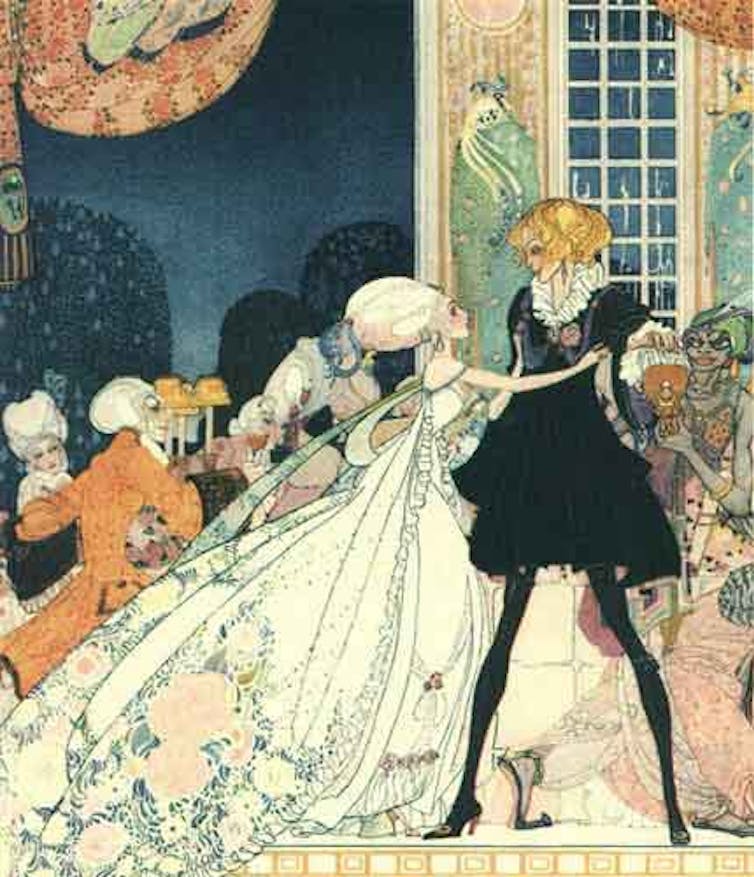
The Twelve Dancing Princesses. Georges Nijs
 The Twelve Dancing Princesses. Georges Nijs

This poem also starts with a tune

open sheet music 


Smoothly spinning round by round, the dainty
sound propels her nimble ever faster
on her toe tip, dances almost fainty;
swirling silk and skin of alabaster.

Then revolving in a vortex nearing
heaven, desperate hope for reaching the light,
when she tosses down on the gateway hearing
seven ditties in speaking: God of the night

will not let you stay. The land of beauty
is not for the living. Yet on grassland
thousand flowers throbbing in a fluty
wait for dancers colouring the world unbanned.


There is no escape. Death is certain.
Bring the golden cup and lift the curtain.


(On the The Twelve Dancing Princesses by Alexander Afanasyev, Samhain 2021)

Sonntag, 17. Oktober 2021

The touch of autumn flowers

16:47


I wrote this for the following music


 Before the morn, still drowse he strolls the park,
the shadows of old souls between the shrub.
The dawning opens airily cracks in the arc,
invokes the Eastern Purple to bloom and drub.

The aura, autumn's tender  glow, contours the trail
releasing all of well-disposed bouquet.
Selected medicine to be hale,
a few lanceolate leaves snapped away;

a crate full of her capitula. Ghast
two gophers rush to hide in Jörd's labyrinth,
desire to stay home when the night has passed
the spiny urchins can heal ailment of wind.

Sweet dew that dribbles softly on his thumb,
a spell within this vale that leads beyond.
 
(Echinacea purpurea)
Echinacea purpurea 
 
 
And then, the warmth of golden rays of sun,
the glory of elves invades the garden bed
calls butterflies, bees and birds to come
the first frosty nights so forcefully fled.

He picks the weed and fills the pipe.
A spectre arises from colourless smoke; swan
of blood that cursed me to feed the ripe
of ravens, vain oblivious desire's mere van.

An evil is your tenderness sweet Helenium!
Reflections in the thousand flakes of glass,
the mirror of loss of friends, the premium,
do daunt the soul of heroes; defeat alas.

Respect makes gentle the heart of these,
when Leda's daughter is weed for sneeze.
 
 
 (Helenium autumnale)
Helenium autumnale


 The tears of Frigg enclose the blue-gray pond
Delight of Odin keeps a secret in the case;
a lore by which could be possessed the monde
behind the magic shield frenzies Odin's Grace.

And out of giantland the daughter of night gave birth
to the rare spark of light, the lover's son.
From sky energetically gores fire to earth,
the blood-worm marks on skin clear become:

The message from the ageless go-between,
to look into all the worlds and while
neglect of weak, eschew in Baldr's dark dream
bring death; the fates behind, they reconcile.

With Cranesbill enwrap your thumb's sharp wound.
The curse, the fiery of love, will be bound.


(Geranium sylvaticum)
Geranium sylvaticum


Beneath the verdant arbour find resort
the paramour's sweet sedative the hind
attracts, before she's stroke and snorts.
"Be mine", he softly whispers, "dance and grind!"

The bumblebees stop to see the spectacle,
to learn of verities the earth concealed,
surround and whirl the clovers receptacle,
until the box's secret is revealed.

For good the flowers are arranged,
with care assorted, ceramic urn - a gift.
Soon autumn transforms to stay unchanged
its seeds fall down to sleep under the skift.


Prepare a petal toner, and your skin
thus varies to see fairies and anew begin.


(Trifolium pratense)
Trifolium pratense

Dedicated to the Gardener. 
 

Mittwoch, 23. Dezember 2020

My silence within you

19:28

My silence within you

 by Tabea Hirzel


It is my silence within you

I'm searching for.


Some words are like a shield 

to protect thoughts and thighs 

but in your presence 

this shield becomes a boat

on which I can cross 

the river to your eyes.


And deep inside your soul

I find my silence.


It is my silence I seek 

in the words You speak

the necessary and not more

and yet, 

you dominate 

from the start.


It is my silence within you

from which you listen 

and you hear

the art 

of painting memories 

in the offing.


And it is this music

that sounds 

and resounds 

now and here in my ear

which lets me doffing

the veil to your heart.


(23/12/2020 - Catching the spirit.)

A dream long dreamed

18:56

A dream long dreamed

 by Tabea Hirzel


We all have dreams

long forgotten

dreams of what 

we wished we had

we could have been become

dreams of what 

we could have done

and yet

from all the thousand options

we chose 

just this one.


We all have dreams

dreams of a future

that turn into fears 

the older we become

and in all those dreams

we paint with delicacy

an alternative version

of this dream

long gone.


To recover 

what has not completed 

what has not been realized 

until now

to recover who we were 

when we were younger 

who we were

who we are

and will be 

forever now.


One part inside me

is not here

and I find it in you

if I want it back

you will not be there

and I will miss 

the tension

between I and you.


(21/10/2020 - In memory of a unique moment beyond time.)


Sonntag, 10. November 2019

Desire unfulfilled

10:43

Desire unfulfilled

by Tabea Hirzel


Desire 

yet unfulfilled

not telling 

the unspoken.


A fire 

privily instilled

draws me 

to be woken.


The void

that arises

hurts and creates 

a field of gates.


A decoyed

that comprises

its own strain

a taunting chain.


Or a bow

pointing against

the heavens

full of resins.


The sow

that commenced

to draw

a dewy token.


(23/11/2019 - Discovering a new dimension.)

Mittwoch, 27. Juli 2011

Sophia and Polemos

09:03

Sophia‘s Fall


Sophia dances and swings to the music spinning her circles, as she stumbles over Polemos.
Sophia: Ow, what are you doing here?

Polemos: And you?
Sophia: I'm dancing.
Polemos: This is not doing. It’s being.
Sophia: Why should I do something?
Polemos: Don’t you see the peoplei suffer!
Sophia: Do they or are they?
Polemos: What do you mean?
Sophia: Do people suffer or are people suffering?
Polemos: I do not understand.
Sophia: Give me an example for their suffering.
Polemos: Just now, I was in Zurich on September 9, 1848. Brothers have hit each other on their heads until destruction.
Sophia: Yes, isn’t this what people always do?
Polemos: True, but afterwards they sat together again all at one table tolerating each other.
Sophia: That's nice. Where is the problem?
Polemos: That almost didn’t turn out well. In Paris, it was much worse. Half of Europe is still half-mad by its memory. If they don’t learn how to keep within boundaries, then, one day, they will destroy themselves.
Sophia: So what? Then something will be created.
Polemos: Sophia!
Sophia: I do not understand your dismay. If they didn’t argue, they would simply cease to be. What do you prefer not to be born or not to pass?
Polemos: To be!
Sophia: Like a sound without body?
Polemos: What do you mean?
Sophia: Energy is eternal, immortal, uncreated. But what people love is the mass, energy that comes to be "some-thing". But mass is defined, it does not just flow. It has resistance and borders on. People cannot just "be". They can only be human. The "being-in-itself" is nothing specific. Do you see that river? It is not a river, because it carries water. But because i t is limited by a bank. Without the borders, it would not be a river, in the best case, just water. If there was no water flowing within the limits of the shore, we still could speak of a dried out river and a dry river bed. We do this because we know that there was a river that formed the bed. The mass of water fighting its way through the mass of the land has created the furrow, which is now its memory. If the water had flowed across the landscape, without friction, then we would not remember it, there would be no river and it had never existed.
Polemos: But the Swiss?
Sophia: They're like a river bed, dried out, over which the wind sweeps and smoothest its furrows. Soon no-one
ii will remember them.
Polemos: But they have achieved great things.
Sophia: Great?
Polemos: Yes, peace! A peaceful union of completely different ideas, pluralism, neutrality, the victory of reason over passion.
Sophia: Polemos, please, let me dance again!

With this statement of outrage, Sophia turns around and spins her loops.


Reason


Polemos rushes into the room and throws the dancing Sophia down. She screams out loud. This time, she is seriously injured and has to sit down. Her ankle is sprained.

Sophia: Do you have to rush like this? Look what you've done? What is there so urgent?
Polemos: The people.
Sophia: They, again! Is there nothing else in our creation, which you can worry about?
Polemos: Yes, but the people, they are special.
Sophia. Ah.
(Sophia exhales this "Ah" pathetically out and rolls her eyes.)
Polemos: Don’t be so indifferent. Human beings are unique.

Sophia frowns thoughtfully.

Sophia: Well, with my foot, I cannot dance for a while anyway. Let us sit together. What makes people think to be so special?
Polemos: They are ethical, they know good and evil.
Sophia: Yes, yes, this nonsense - which they owe you. I even warned them; to eat from this fruit would make eternal life
unattainable.

Polemos laughs out loud.

Polemos: Ha, you see, it's not my fault. If mankind never had learnt about the prohibition, they would never have been tempted to trespass it.
Sophia: What fault? I've never banned anything. I've just given them the knowledge that the distinction between good and evil will convert eternity unattainable. I showed them my wisdom, but they could do anything with it. I did not make the laws, they are forever. I am the eternal law.
Polemos: You mean, if people get aware of themselves, know their own will, they may desire the good? Then they will want what is good?
Sophia: Polemos, please. I think we talk past each other.
Polemos: We almost always do.

Sophia sighs and rubs her sprained ankle.

Sophia: Yes, almost always. You see, I must give you right. Humanity is unique. They believe that there is a difference between good and evil. It is not their particular shape or their special ability that distinguishes them. It is their particular problem; to see the world not as it is, but to think in categories.
Polemos: Very good. Then you agree with me that only human beings are rational?
Sophia: No. But is that relevant to the question?
Polemos: Well, you mean, due to people’s distinction between good and evil, evil has become a problem?
Sophia: Exactly.
Polemos: Then, we should just explain to them that good and evil do not exist. That it’s all an illusion.
Sophia: You want to dissuade people from thinking? Good and evil are real. Have not you been so outraged by the battle campaigns of virile young men? I drink their blood.
Polemos: Sophia, please, spare me with your stinking archaic! It hurts in my ears.
Sophia: Excuse me. I am the origin.
Polemos: I know, but could we leave this aside for a while and convers in civilized manner?
Sophia: Civilized?
(She laughs to herself, and wrinkles her forehead.) What do you mean by civilized?
Polemos: The search for the good, the beautiful. The good for the people.
Sophia: Ah, well. What is good for the people? To live forever? Without pain, without interference? In peace as I am?
Polemos: Yes!
(His face lights up.)
Sophia: Then they would cease to be human, give up living. Life is in the world. The world is peace. The world is life. I'm “no thing”, I'm just being.
Polemos: Then it is life that makes humans unique? And peace, the pursuit of the good what distinguishes them from others?
Sophia: They are different from us through their existence. Only what exists
iii, dies, lives. We do not die. But, it does not distinguish them from other existences in the world.
Polemos: And peace?
Sophia: Peace is not the striving for the good. Do you remember? When people started naming the world, they created this distinction between good and evil. They were not content to be related to the world, they wanted to take control, just as if they were not in the world, as if they could break away from it and look from outside. Only when they were no longer in the world, they could view the world as the Other
iv. They were no longer the world but detached from it. Then they began to give names to the world and its creatures, to set immutable limits, to de-fine. They began to demarcate space and time, to chop everything into pieces and count the parts, compare, and order them into equal and unequal. That's categorical thinking. Only a being alienated from oneself, which dissolves oneself from the world, is able to do so.

Polemos sits up and boasted.

Polemos: They owe this to me! I showed them how they can rule the world, how they can be like you.
Sophia: Like
v me? They are always me; they just don’t know. Why did you do this?

Sophia looks distraught at Polemos.

Polemos: I wanted to be like you. So gentle and carefree dancing in front of me.
Sophia: You are already.
Polemos: Yes, but bumping all the time into you.
Sophia: Or, me into you?
Polemos: I've never seen it that way, before.
Sophia: Do you now, why people live in dispute? Their arguing is their reason.
Polemos: But reason is good. It allows anticipating the future and avoid evil. Reason gives people the opportunity to live in peace.
Sophia: They do live in peace.
Polemos: I mean maybe they achieve to prevent destroying themselves.
Sophia: To destroy themselves?
Polemos: To destroy.
Sophia: Destruction, from “not being”?
Polemos: Exactly.
Sophia: There is no “not being”, everything at all times in all-ways, is.
Polemos: I mean, stop being Man, that there would be no more people at some point, no birds, no trees, no rivers.
Sophia: And they want to prevent that by making use of reason? It is in the nature of human beings to be finite and not eternal. Existing, “being-as-such”
vi is always de-fined, limited, unique and voidvii. We both know that humanity will come to an end. And we also know when.
Polemos: Sophia, do you not see how much the people suffer? They fear their end.
Sophia: Indeed, I have warned them!
Polemos: Do you want to leave the human race just to their demise?
Sophia: Not just like that. Their end is included in their beginning. There is no beginning without a passing away. And being human is finite. What difference does it make if people die at the end of their lives or perish together with the whole humanity? If they are so reasonable, they already should know that this world has an end.
Polemos: Yes, but in such a large-scale period that it is not relevant for humans.
Sophia: What then is relevant to humans?
Polemos: They want to believe that their life has meaning and that something is left behind when they die.
Sophia: What a crock! Of course there is something that remains. Didn’t we agree that energy and mass are an entity? They cannot be destroyed.
Polemos: Yes, but people want something that is left of them, something that makes sense.
Sophia: Don’t I make any sense?

Sophia gets up angrily. Her foot is apparently better.

Polemos: Yes, but people want to ...
Sophia interrupts Polemos: People want very often, it seems.

With those words, she turns around and sashays on her lap. Polemos dances, too.


Meaning


For a while, Sophia and Polemos do not cross each other’s loops. Then, suddenly, they repel against each other in a reverse rotation.

Sophia and Polemos simultaneously: Ouch!
Sophia: Now, I've run into you.
Polemos: If you say so. I prefer to think that I've pushed you around.

Sophia smiles.

Sophia: Still worried about humanity?
Polemos: Have we agreed that people are unique because they have ethical reason?
Sophia: Ethical reason? How much you love abstraction! No. That does not make them unique.
Polemos: Well, it is their suffering that makes them unique?
Sophia: Is it?
Polemos: Human beings are the only beings who try to divide the world into categories, in order to understand relationships and to predict the impact of their deeds in the future, to bring about the good and avoid evil.
Sophia: Polemos, you are too fast. Even if other beings could create categories, too - a point that is not under discussion here – so, the only persons who apply these categories to the world and divide it into good and bad, are human. This makes them suffering less at the moment, because they can set their suffering into a broader context. But they suffer more, at the long run, because they mourn the loss of their immortality. To be human is profoundly being mortal. To what extent will the ability to predict events reduce that suffering is not clear to me.
Polemos: Well, if people know what is good, they may avoid evil.
Sophia: How? What is it, evil?
Polemos: Death.
Sophia: How to avoid death by reason?
Polemos: By giving life a transcendental meaning.
Sophia: Transcendental? Don’t you have a proper language?
Polemos: Well, meaning that remains of a man, after her death. A sense by which the eternal in man can shine through.
Sophia: There is nothing eternal in the human condition. The eternal, that could shine through, there, is not humane.
Polemos: Yes, but man wants to have a meaning.
Sophia: Everything created has a meaning. Meaning is expressed through creation.
Polemos: Man wants to have significance beyond oneself, not go lost.
Sophia: Everything that is found will go lost again.
Polemos: No!
(Polemos horrified screams.) Human beings need to be connected to the Eternal.
Sophia: And that they want to achieve by separating the connection first?
Polemos: They need to recognize the good in order to achieve the good.
Sophia: And what is good for humans?
Polemos: Eternal life.
Sophia: But human existence is not eternal.
Polemos: That’s why people want to fit themselves into an eternal context, see themselves as part of an infinite whole.
Sophia: The infinity has no parts. The whole thing is entire, because it is undivided.
Polemos: That is obvious. But mankind is afraid of disappearing.
Sophia: Are they afraid of appearing, too? Is man not equally afraid of life
viii as of death?
Polemos: I think so.
Sophia: What could reason be good for then?
Polemos: Through it, humans can foresee their death and divide their time properly, plan their lives and work for the good.

Sophia paints her nails, clearly bored, and dreaming ahead.

Sophia: How can a person predict death by reason?
Polemos: Not the exact date, but they may become prepared to die so that they will consider their lives and make sense out of it.
Sophia: I do not understand. Did you not say that mankind suffers because they know that they will die? How should this knowledge, now, comfort them, at the same time? Man makes sense, as much as “any-thing”. Why should they require giving meaning for their lives?
Polemos: Through the search for meaning people try to contact with you.
Sophia: Oh, there you have it. The people are always connected with me. Through me they are connected with everything. It is their reason that makes them believe that they are not in this universe, as if they were outside.
Polemos: So, do you think it does not matter what people do? They will die anyway, their world will be destroyed anyway, and they will cease to be.
Sophia: They will die, their world will pass away but they will not cease to be. They will cease to be human. Then they will be like me. It is not indifferent what they do. They are what they do. Their actions express their humanity. Their relentless pursuit of uniqueness, their struggle for distinctiveness of the world, their fight with me, this is what makes the people human and unique. They and only they question me. They and only they give me names. Through them I may be mortal myself, I can be a "something".

Sophia's eyes begin to shine in these words.

Polemos: You love the human beings!
(He is very surprised.)
Sophia: Love? Can we leave this issue aside?
Polemos: Good. So you mean that it is their separation from you, which distinguishes them. This separation is caused by their reason? And now mankind is suffering from this separation, in its finitude and tries to reconnect with you in order to be immortal?
Sophia: Humans do not understand that meaning lies only in finiteness.
Polemos: Hm, but it is still not clear to me how people can know what is right or wrong.
Sophia: Not the knowledge of right or wrong gives meaning to the people, it is their reason that divides meaning into right and wrong.

With these words, Sophia disappears and leaves Polemos alone. He spins circles on the spot.


Responsibility


Polemos is circling around, when Sophia appears on the horizon. Polemos wants to escape her, but inevitably encounters with Sophia. Sophia laughs and falls.

Sophia: We cannot change our course. It is an eternal flow, remember?
Polemos: Wouldn’t it be good to avoid such a collision? It still hurts.
Sophia: But, have you seen what comes out of it!

Sophia points with her index finger to the deep sea in the Indian Ocean.

Polemos nods: I understand. Nevertheless, precisely this was the cause of the quarrel, which I heard in Zurich. The people with their divergent ideas clashed. Would it not have been good for them to have a clear, objective answer to settle their disputes?
Sophia: Would it be better if the universe was a flat disc instead of a ball
ix? Parallel circles on a disk never overlap. However, we push each other constantly. The eternal circle does not create and destroy anything. There is nothing that is. Only flow. Would you prefer this?
Polemos: Of course not!
(He looks at Sophia as if she was a stupid child.) But if there was a point from which everything could come from?
Sophia: So it would never return. Then there would be no world, just an infinity of beings sent out to be lost in the boundless space
x.
Polemos: But a rule, a law would make it easier to settle disputes.
Sophia: There's a law! I am the Law. Everything that is born will die.
Polemos: But how should people act?
Sophia: Humanly?
Polemos: What does it mean to be humane?
Sophia: You've explained it before long and widely; reasonable and ethical, longing after the good.
Polemos: But you said that good only exists because humans differentiate it as distinct.
Sophia: Exactly.
Polemos: But they do not distinguish it in the same way.
Sophia: Are you sure? What was that like for your people in Zurich?
Polemos: They sought liberty as their highest good. But the French search for freedom ended in slavery. This had shaken them. Therefore, they doubted these ideas and sought other possibilities.
Sophia: Freedom! I thought they wanted peace?

Sophia is very sweaty and sits down.


Liberty

Polemos: Human beings want to live by their own rules, not enslaved by the laws of nature, gods or other humans.
Sophia: I see. (Sophia looks thoughtfully to herself.)
Polemos: Their rationality makes them free. Through it, they recognize their uniqueness and their distinctness from the world.
Sophia: That's correct. But they cannot want peace and freedom. Peace is in the world, freedom is out of the worldxi.
Polemos: Then, only war remains to mankind?
Sophia: Are we waging war against us?
Polemos: Well, we bump together constantly.
Sophia: But it also gives us a moment to pause and lead idle talks about humanity.
Polemos: That is correct. Without collision, we would eternally circle in parallels and never meet. Nothing would come out of it, no time, no space, no “Uni-verse”xii.
Sophia: Why should it be different for humans. At the end, they, too, have come out of us.
Polemos: You mean, rationality makes people free from the world. Their free acting creates the sense of good and evil. Then, poking through their interaction with other people, they will pause and move on to require answers. This is how through freedom they ultimately become “respons-ible”?
Sophia: Yes, exactly.
Polemos: Then is suffering part of being human?
Sophia: You cannot prevent suffering. But their suffering compels them to give answers; to the culprits of their suffering, to their victims, to themselves and to us. By responding the call of suffering they come into contact with us and give us a face.
Polemos: Then we should be thankful indeed to humanity.
Sophia: And we are.
Polemos: But if they cease, now, their world ends?
Sophia: Then we will re-createxiii.

With these words Sophia gets up, bows before Polemos floats away in a dance.

i It is not the same to say “people”, “humanity”, human beings”, “man”, “mankind”. So far, I have not analysed the differences in here and use them more or less instinctively.
ii No-body or no-one, no man. This is one of the seldom coincidences between English and German semantics, while in German “niemand” is “not a man”, the English uses “not a body”. In Russian, on the other side “никто, никого, не нибудь”, could be used for other-than-human persons (vs. no man/niemand) or for bodiless beings (vs. nobody). No-one is the most universal in this world and addresses the idea of “identity” and “unity” of an existence. In order to find the right translation, it requires to know what/who is capable of memory.
iii The English word „to exist“ comes from Latin „sistere“, to stand, persist, appear emerge[ CITATION Oxf111 \l 2055 ]. It expresses very directly its relation to the phenomenology of distinct entities in the world related to a concrete space-time phenomena.
iv For the whole philosophy of „Otherness“ refer to Emmanuel Levinas and Pedro Laín Entralgo.
v „Like“ has a very compromising semantics here. It comes from the old German word “Liche” and means “to have the shape or form of”. In modern use the word makes assimilation. Both translations are wrong. The word is used in failure of a better translation. It touches the Christian idea of theosis, interpreted as “unio cum Cristo”, the transcendence as “God in man” defended by John Locke and the European Enlightment movement. It is also very much present in the Mahayana Buddhism.
vi See Heideggers definition of „Sein-an-sich“
vii The original German word „nichtig“ becomes a completely new dimension when translated into English. It makes believe, that existence is equivalent to the mathematical 0 as long, as it is not in a relationship.
viii This refers to the complete discourse between Levinas and Heidegger.
ix This refers not to an empiric statement about the Universe as being a ball, but to a symbol for the geometry of the logic of the metaphysic proposed here.
x It is not clear, if we should speak of a space, if there are no borders… perhaps we could speak of khora here.
xi This idea emerges from a play with words in the Russian translation.
xii „Uni-verse“ in English and „All“ in German, emphasize both the totality and unity of beings, while English in addition mentions the movement or rotation.
xiii In the original German text it is „we will probably recreate them“. But from the monadic point of view, in this play, it is not possible to repeat creation. Further, from the geometry of this metaphysic it is not “probable” but “certain” that creation is an on-going process.